
Moroccan Festivals: Celebrating Culture Through Tradition
Moroccan Festivals: Celebrating Culture Through Tradition
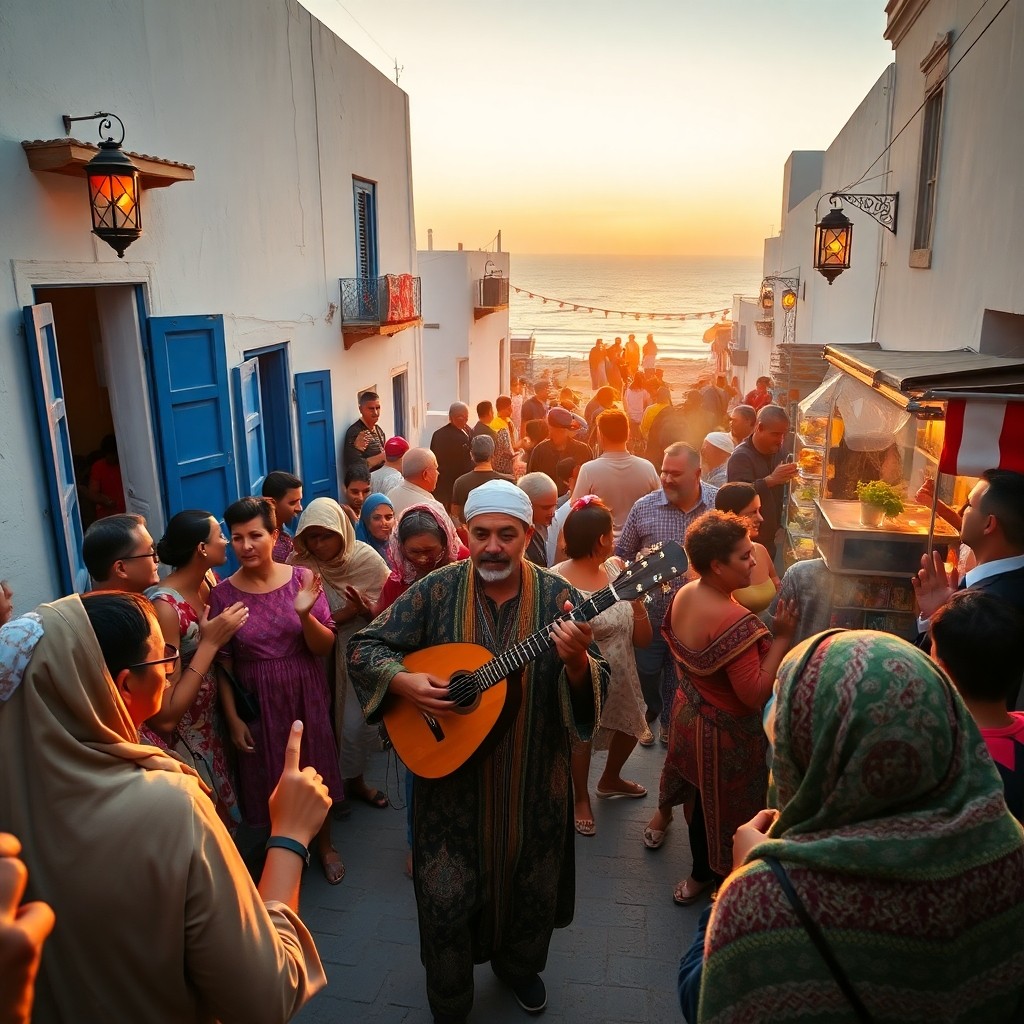
The drumbeats hit you before anything else — deep, resonant tones from the *guembri* that vibrate through the narrow streets of Essaouira just before sunset. Smoke from a hundred food stalls curls into the Atlantic breeze. A Gnawa *maalem* (master musician) begins a call-and-response chant that traces its lineage back to Sub-Saharan African ancestors brought to North Africa centuries ago. Children weave between legs, vendors shout prices for mint tea and grilled sardines, and strangers become dance partners without exchanging a single word. This is not a museum exhibit or a staged heritage performance. This is how Moroccan festivals actually feel — alive, chaotic, sacred, and profane all at once.
Morocco sits at a geographic and cultural crossroads where Berber, Arab, Andalusian, Jewish, and Sub-Saharan African traditions have blended for over a millennium. The country's festival calendar reflects that layering in ways few other nations can match. From Sufi night ceremonies that induce spiritual trance to Berber marriage markets in the High Atlas, from world-class music stages in Fes to olive harvest celebrations in the Rif Mountains, these gatherings function as living museums of Moroccan identity — places where culture is not merely displayed but actively practiced, debated, and reinvented.
Moroccan festivals matter culturally, spiritually, and economically. Sacred pilgrimages survive in an age of Instagram tourism. Berber harvest rituals face pressure from rapid urbanization. Centuries-old traditions become government-backed "brands." A harvest festival in the Rif Mountains teaches lessons about community resilience that resonate far beyond Morocco's borders.
The Spiritual Heart of Moroccan Festivals: Moussem Pilgrimages and Sacred Gatherings
What Is a Moussem?
*A master Gnawa musician leads a call-and-response performance in the narrow streets of Essaouira, capturing the spiritual and communal energy of Morocco's living festival traditions.*
A moussem is one of the oldest forms of communal gathering in North Africa — a traditional pilgrimage centered on the tomb of a Sufi saint, or *wali*. The word itself comes from the Arabic *wasm*, meaning "mark" or "stamp," suggesting an event that leaves a permanent imprint on a community's identity. Unlike secular music festivals or commercial trade fairs, moussems blend religious devotion with commerce, music, social bonding, and even political negotiation. They typically occur annually on the anniversary of a saint's death and can draw tens of thousands of attendees from surrounding regions.
The origins of moussems are layered. Sufi brotherhoods (*tariqas*) formalized many of these gatherings during the 16th and 17th centuries, but their roots reach into pre-Islamic Berber traditions of seasonal assembly and ancestor veneration. The result is a hybrid event that orthodox Islam sometimes views with suspicion but that rural communities consider essential to their spiritual and social calendar.
The Moulay Abdellah moussem, held each August near El Jadida, ranks among the largest and most vibrant. Attracting an estimated 300,000 to 500,000 visitors over several days, the gathering transforms the small town of Moulay Abdellah into a sprawling tent city. Horsemen perform *fantasia* — a synchronized cavalry charge where riders fire muskets in unison — while traders sell everything from handwoven blankets to livestock. Sufi groups set up dedicated tents for *dhikr* (remembrance of God through repetitive chanting), and families camp for the duration, turning the event into a temporary autonomous zone where normal social hierarchies soften.
The Role of Sufi Brotherhoods (Tariqas)
Sufi orders like the Gnawa, Issawa, and Hamadsha use moussems as settings for *lila* — nighttime spiritual ceremonies that can last until dawn. These rituals are not performances for spectators; they are participatory acts of devotion, healing, and community catharsis.
A typical Gnawa *lila* follows a structured progression. It begins with the *aada*, an invocation where the *maalem* plays the *guembri* (a three-stringed camel-skin bass lute) to call spirits and ancestors into the space. The *krakeb* (metal castanets) enter next, establishing a rhythm that shifts through seven distinct modes, each associated with a specific spiritual entity and color. Participants — often members of the community experiencing illness, grief, or social distress — gradually enter trance states as the music intensifies. The ceremony builds toward the *daqqa*, a climactic drumming sequence where the collective energy reaches its peak. By dawn, participants describe a sense of purification and renewal that no clinical therapy could replicate.
These ceremonies have drawn the attention of anthropologists and musicologists worldwide. The Gnawa *lila* in particular has influenced jazz, blues, and contemporary world music, though practitioners insist its primary purpose remains spiritual, not artistic.
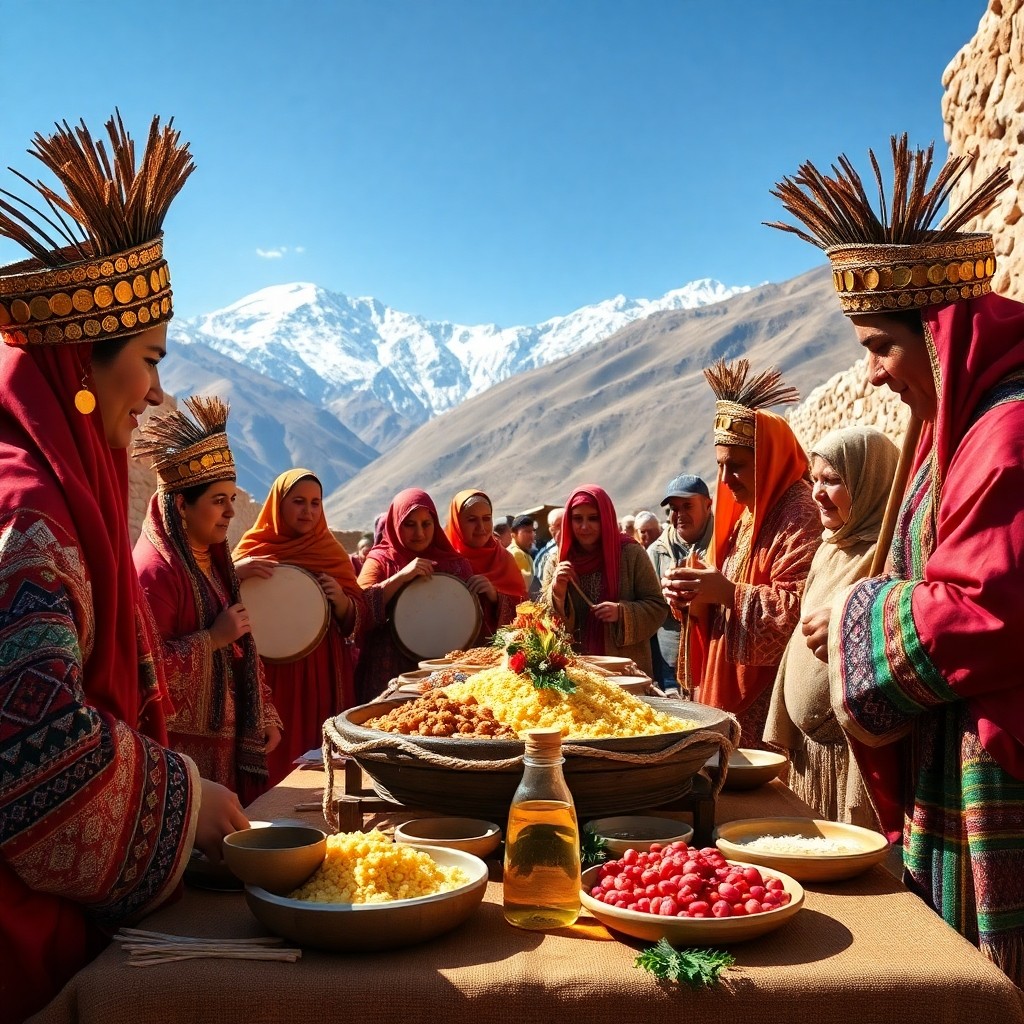
*An authentic Berber wedding celebration in Morocco's High Atlas Mountains, showcasing traditional music, vibrant textiles, and communal feasting as a living expression of Moroccan cultural heritage.*
Tension Between Tradition and Modernity
Moroccan cultural institutions and tourism ministries have increasingly reframed moussems as heritage events, a shift that brings funding and visibility but also dilutes the spiritual core that gives these gatherings their meaning. The Moroccan government's investment in cultural infrastructure has helped preserve many traditions, yet some communities report that the emphasis on tourism can overshadow the sacred dimensions of the moussems.
Younger Moroccans are divided. Some see moussems as outdated superstition; others are rediscovering them as acts of cultural resistance against homogenization. The tension is real and unresolved — and it mirrors debates happening across the Global South about how to honor tradition without embalming it.
Berber Harvest and Seasonal Festivals: Marking Time the Ancestral Way
The Amazigh Agricultural Calendar
Long before the Gregorian calendar arrived in North Africa, Berber (Amazigh) communities structured their lives around agricultural and pastoral cycles. Sowing season, the first autumn rains, the barley harvest, the olive press — each milestone carried its own rituals, songs, and communal obligations. That calendar persists today, and its festivals offer some of the most authentic cultural experiences Morocco offers.
The Amazigh New Year, Yennayer, falls on January 13 and marks the start of the agricultural year. In 2023, Morocco officially recognized Yennayer as a national public holiday — a landmark moment for Amazigh identity after decades of marginalization. Celebrations center on *tagula*, a porridge of barley flour enriched with argan oil and amlou (a paste of almonds, honey, and argan oil). Families prepare the dish at sunset on January 13, and the eldest woman in the household distributes it while invoking blessings for abundance. Symbolic rituals include placing a date pit in the dough — the number of pits eaten supposedly foretells the number of children born that year in the family. In the Atlas Mountains, communities also prepare *irchmen*, a fermented barley drink, and perform traditional songs that predate Islam by centuries.
Imilchil Marriage Festival (Souk Aam or Betrothal Festival)
High in the Middle Atlas, at roughly 2,000 meters elevation, the twin lakes of Isli and Tislit sit in a landscape that looks like another planet. According to local legend, two young people from feuding Berber tribes fell in love but were forbidden to marry. Their grief was so profound that they wept until they died, and their tears formed the two lakes — one sweet, one salty. Each September, the Imilchil Marriage Festival (also called Souk Aam) commemorates their memory and serves a practical social function: it is one of the last places in Morocco where families gather to arrange marriages in a communal setting.
A visitor walking through the festival grounds encounters rows of white tents where families have set up displays. Young women wear striped *handira* cloaks and silver jewelry; young men don traditional *djellabas* and carry ceremonial sticks. When a match is negotiated, families exchange mint tea and the couple registers with a local official. The Ahidous dance — a synchronized group performance where men and women clap and sing in call-and-response — provides the soundtrack. Elders recite oral poetry in Tamazight, and the entire event functions as a living archive of Amazigh social structure, gender roles, and communal decision-making.
The Olive Harvest Festival in Boujad
In the rolling hills around Boujad, northwest of Beni Mellal, the olive harvest is not merely an economic activity — it is a communal festival. Each November, families gather to hand-pick olives from groves that have been cultivated for generations. Local mills open their doors for demonstrations of traditional stone-pressing techniques, and women's cooperatives sell olive oil, *zaalouk* (eggplant dip), and handmade soap. Musicians play *ahwash*, a Berber collective dance accompanied by bendir drums, and storytellers recount tales of the olive tree's sacred significance in both Islamic and pre-Islamic tradition.
Morocco ranks among the top ten olive-producing countries globally, with an annual output exceeding 150,000 tons. In rural communities like those around Boujad, olive cultivation accounts for up to 60% of household income, making the harvest festival both a cultural celebration and an economic lifeline.
Music and Performance Festivals: Morocco's Global Cultural Stage
The Gnaoua World Music Festival in Essaouira
Founded in 1998, the Gnaoua World Music Festival transformed Essaouira from a quiet coastal town into one of the most important stops on the global world music circuit. The festival's genius lies in its format: each evening, a Gnawa *maalem* hosts a different international artist for a collaborative jam session. The result is a musical dialogue between traditions that have never before shared a stage — Gnawa trance rhythms meeting jazz improvisation, West African kora, or electronic production.
The Gnaoua musical tradition itself carries a heavy history. Gnawa people are descendants of enslaved Sub-Saharan Africans brought to Morocco through the trans-Saharan trade. Their music preserves elements of pre-Islamic West African spiritual practice, blended with Sufi Islam over centuries. The *guembri* — a three-stringed bass lute with a body made of camel skin — is the instrument's heart, and the *maalem* is both musician and spiritual guide. The festival has given this tradition international visibility while creating economic opportunities for Gnawa communities who were historically marginalized.
The 2023 edition drew over 200,000 visitors to a city with a permanent population of roughly 77,000, generating an estimated 50 million dirhams in local revenue through hotel bookings, restaurant sales, and artisan purchases. Essaouira's medina, a UNESCO World Heritage site, becomes a stage where every alley hosts impromptu performances.
Fes Festival of World Sacred Music
If the Gnaoua Festival is Morocco's most visceral musical experience, the Fes Festival of World Sacred Music is its most intellectually ambitious. Founded in 1994 by Moroccan writer Faouzi Skali, the festival was conceived as a response to the post-Gulf War narrative of civilizational clash. Its mission: to demonstrate that sacred musical traditions from every culture share more commonalities than differences.
Programming reflects that vision with startling range. A single week might include a Sufi *dhikr* ceremony from the Darqawi order, a Gregorian chant ensemble from France, a Hindustani classical raga performance, and an Andalusian orchestra playing *muwashshahat* composed in 13th-century Seville. Past editions have featured collaborations between Moroccan *maalem* Mahmoud Guinia and American jazz pianist Pharoah Sanders, as well as performances by the Bulgarian State Television Female Vocal Choir and Senegalese griot Youssou N'Dour.
The festival takes place in venues that are themselves cultural monuments — the courtyard of the Bab Makina palace, the gardens of the Riad Fes, and occasionally the courtyard of the 14th-century Bou Inania Madrasa. This setting reinforces the festival's argument that sacred music and architectural heritage are inseparable.
Emerging and Underground Festivals
Morocco's festival landscape is expanding rapidly beyond its flagship events. Visa for Music, held annually in Rabat since 2014, has become Africa's largest music industry fair, connecting artists from the continent and the diaspora with booking agents, label executives, and festival programmers. The Moga Festival in Essaouira fuses electronic music with traditional Gnawa and Amazigh sounds, attracting a younger, digitally connected audience. The National Music Festival, rotating between Moroccan cities, provides platforms for homegrown hip-hop, rap, and Amazigh-language artists who rarely receive mainstream media coverage.
These newer festivals are creating career pathways that didn't exist a decade ago. Moroccan artists who gained early exposure through Visa for Music have gone on to perform at major European and North American festivals, demonstrating how festival platforms can serve as genuine launchpads for emerging talent.
Culinary and Artisan Festivals: Tasting and Crafting Moroccan Identity
Regional Food Festivals
Morocco's culinary festivals are sensory immersion experiences that double as economic engines for rural communities. The Rose Festival in Kelaat M'Gouna, held in the Dadès Valley each late April through early May, celebrates the blooming of the damask rose (*Rosa damascena*). The festival features on-site distillation demonstrations where visitors watch fresh rose petals being processed into rosewater and essential oil — products that sell for up to 5,000 dirhams per liter. Local women's cooperatives operate most of the distillation operations, and the festival generates an estimated 30% of their annual income in just two weeks.
The Almond Blossom Festival in Tafraout, held in February, marks the blooming of almond trees in the Anti-Atlas. The Date Harvest Festival in Erfoud, each October, celebrates Saharan agriculture with camel races, date-tasting competitions, and traditional Saharan music. These events are not theme parks — they are working agricultural fairs where farmers negotiate prices, share techniques, and celebrate a harvest that sustains their families for the coming year.
Artisan Craft Fairs and the Living Souk
Major festivals increasingly incorporate artisan pavilions where master craftspeople demonstrate their techniques. At the Marrakech International Film Festival, a parallel artisan market showcases zellige tilework, Berber carpet weaving, and traditional leather tanneries. Women's cooperatives from rural areas use these events as primary sales channels, often earning more in a single festival week than in a month of local market trading.
A Berber rug, as demonstrated at a typical artisan festival booth, begins with carding raw wool by hand — a process that takes several hours per kilogram. The wool is then spun on a drop spindle, dyed using natural pigments (saffron for yellow, indigo for blue, poppy petals for red), and woven on a vertical loom. Each knot is tied by hand, and a single medium-sized rug can contain over 100,000 knots, requiring two to four months of work. The geometric patterns — diamonds, chevrons, and crosses — are not decorative abstractions but Amazigh symbols representing fertility, protection, and tribal identity.
The Intersection of Food, Craft, and Storytelling
Walking through the Erfoud Date Festival at sunset, the air thick with the smell of roasting camel meat and fresh medjool dates, you realize that Moroccan culinary and artisan festivals are not commercial events in the Western sense. They are acts of cultural transmission. Grandmothers teach tagine recipes to grandchildren who might otherwise learn from YouTube. Potters explain Amazigh symbols to visitors who carry that knowledge home. The festival is the classroom, the marketplace, and the archive — all at once.
The Economics and Politics of Festival Culture in Morocco
Festivals as Tourism Infrastructure
The Moroccan government has strategically positioned festivals as central pillars of its tourism diversification strategy. Beyond the "big three" destinations of Marrakech, Fes, and Casablanca, festivals draw visitors to secondary cities and rural areas that would otherwise see minimal tourism revenue. The Morocco 2020+ tourism vision explicitly identified cultural tourism — including festivals — as a priority sector for investment and international marketing.
Morocco welcomed over 14 million tourists in 2023, with cultural tourism (including festivals, heritage sites, and artisan experiences) accounting for a growing share of visitor spending. Essaouira's population of 77,000 swells to over 200,000 during the Gnaoua Festival weekend, filling every hotel, riad, and Airbnb in the medina. The economic multiplier effect extends to taxi drivers, food vendors, and souk traders who report festival-week earnings that rival an entire month of normal business.
Who Benefits? Gentrification, Access, and Local Voices
The festival economy is not without its tensions. In Essaouira, average rents in the medina have increased by an estimated 300% over the past decade, driven largely by festival-season demand and foreign property investment. Long-term residents — many of them fishermen and their families — find themselves priced out of neighborhoods that their grandparents built. Marrakech faces similar pressures, where festival-driven tourism has accelerated the conversion of traditional riads into boutique hotels and guesthouses.
Local business owners and community organizers describe a double-edged dynamic: festivals bring vital income but also risk displacing the very communities whose culture is being celebrated. The question of who controls the narrative — and who profits from it — remains unresolved.
Digital Transformation and the Future
Moroccan festivals have adapted to the digital age with varying degrees of success. During the COVID-19 pandemic, the Gnaoua Festival and Fes Festival both pivoted to hybrid formats, livestreaming performances on YouTube and social media platforms. The 2021 Gnaoua Festival livestream reached an estimated 2 million online viewers globally — a digital audience that dwarfed the in-person attendance of any previous edition.
Post-pandemic, festivals have maintained digital components as standard practice. Visa for Music developed a year-round digital platform for artist showcases, and the Moga Festival uses Instagram and TikTok to build anticipation months before the event. These digital strategies extend the festivals' reach and revenue potential beyond their physical dates, though they also raise questions about whether a livestreamed *lila* ceremony carries the same spiritual weight as one experienced in person.
The pandemic accelerated a trend that was already underway: Moroccan festivals building permanent digital archives. The Fes Festival now maintains a searchable database of past performances, making sacred music traditions accessible to researchers and enthusiasts worldwide. Several moussems have begun documenting their rituals through video, creating records that may prove invaluable as elder practitioners pass on. This digital preservation work represents a new chapter in how Morocco safeguards its intangible cultural heritage — not by freezing traditions in time, but by ensuring they remain discoverable and contextualized for future generations.
Conclusion
Moroccan festivals are not frozen relics preserved under glass. They are dynamic, contested, and evolving expressions of identity — places where Sufi devotion meets Instagram aesthetics, where Berber harvest rituals coexist with government tourism campaigns, and where a Gnawa *maalem* can share a stage with a Norwegian jazz pianist and make it feel inevitable rather than forced.
The drumbeats that echo through Essaouira's streets during the Gnaoua Festival are the same rhythms that have sounded in Gnawa communities for centuries. But the context has changed. The audience is larger, more international, more commercially minded. The tension between preservation and commercialization is real, and it will not resolve neatly. What matters is that the conversation is happening — within Moroccan communities, among scholars, and increasingly among visitors who come not just to watch but to understand.
In a rapidly globalizing North Africa, Moroccan festivals may be the country's most powerful argument for the enduring value of tradition. They prove that culture is not a static inheritance but a living practice — one that requires participation, debate, and the willingness to change without forgetting. If you want to experience that argument firsthand, plan your visit around a festival date, arrive with respect and curiosity, and let the drums do the rest.
**Meta Description:** Discover how Moroccan festivals — from sacred moussem pilgrimages to world-class music events — preserve centuries of Berber, Arab, and African tradition. A complete cultural guide.